

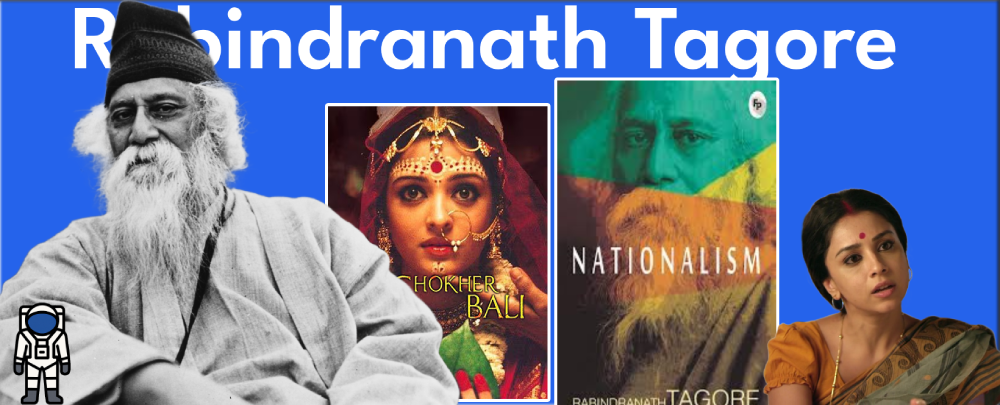
Art vs. Science: Tagore’s Vision for Humanity
If you live in India & visit a Bengali house, you will find one thing common in every house. A BIG PICTURE OF RABINDRANATH TAGORE. Having been born in a Bengali culture, Gurudev is like a god to us. He is one of our emotions that unites us across the globe. We act like he is the one (the chosen one) who has all the answers & will uplift our community & India as a country altogether. We teach our child his recitation, we celebrate his birthday like he is one of us who live in our home. We refer to his poem, songs, and quotes with every emotion of ours. When we are sad, we recite “bojapora”, when we are in love, we recite ananto prem, dhan, etc.
Every Bengali artist worships him & some of the artists like Brototi Bandapadhaya have devoted their lives to Rabindranath (BTW I love Brototi mam, she is a gem, once in a lifetime).
Those of you who don’t know rabindrath tagore, Google him. I am not gonna waste time on info which are already available on the internet. Now, without further ado, let’s go to the main topic of today’s article –
Tagore’s Thoughts on Nationalism and Humanity
Gurudev wasn’t a fan of colonialism, but he also wasn’t a fan of nationalism either. He wrote a lot about it, especially in Japan, and he thought it would cause trouble both here and overseas. To him, nationalism was like a crazy idea that always led to war. He even believed that the two World Wars were partly caused by nationalism.
For Tagore, nation-states were like big machines that wanted to grow and take over other places. He warned that they could become too powerful and only think about their own people, ignoring problems like hunger or suffering in other countries.
Take, for example, the fact that some countries waste food while others are starving.
Universal Humanism
Tagore thought that the brightest part of our lives shines when we see ourselves in others. He valued universal humanism more than just material success. Real progress in our world comes from looking beyond borders. India, Persia, Greece, Egypt, the US, and the UK are like different peaks on the same mountain of humanity. A truly free person is one who thinks beyond their own country. He believed “Being selfish can be a real drag, but once you move past greed, you’ll find true happiness.”
Criticism of Rationality and Nationalism
Tagore, much like Dostoevsky, wasn’t a fan of nationalism and modern rationality, which he felt often made people feel like mere objects. He painted a picture of modern man as a bit of a giraffe, with his head up in the clouds of power and success, while his heart was down in the valley of sorrow and emptiness. He thought that knowledge and efficiency were like hotels—they were clean and nice, but they were missing the real heart and soul (the “host”). For Tagore, education should be like a journey of self-discovery, not just a way to be forced to learn.
Art vs. Science
Science tends to reduce people to just numbers and statistics. (Dovtoysky also told the same thing)Art, on the other hand, makes each person a unique character with their own emotions. Take Einstein and Alfred Nobel, for example: brilliant minds whose intelligence helped create some pretty devastating things (like the atomic bomb and dynamite). Tagore believed that to really understand others, we need to go back to art and stories.

East vs. West Humanism
Western humanism, rooted in Christian beliefs (everyone’s equal), shifted towards reason during the Enlightenment. Western science aims for a single truth, but Tagore pointed out its intolerance for multiple perspectives. Indians often turn inward through meditation, while Westerners tend to look outward through science and action. Tagore advocated for a cultural exchange: The West could benefit from self-reflection and meditation(which the West is now trying to do.)The East could gain creativity and productivity.
Human vs. Nature
Western civilisation often tries to control nature, partly because of the Christian belief that we fell from Eden into a wild world. This view leads to seeing nature as dirty, dangerous, and something to conquer. Colonists treated colonies as “dirty lands” to extract wealth, not as homes or equal places. The English in India, settlers in Africa, and Americans rarely interacted with the locals. Colonial dehumanisation: killing or exploiting others was often seen as acceptable under their moral code.

Story of Kabuliwala – A Lesson in Humanism
Tagore’s short story Kabuliwala tells of an Afghan fruit seller, Rahman, who forms a bond with a little girl, Mini, in Calcutta. Arrested after a street fight, Rahman is jailed. Years later, on Mini’s wedding day, he returns, only to be told he can’t meet her. He tells the girl’s father about his own daughter back in Kabul. Moved by this, the father pays for Rahman’s journey back home. This story shows universal love, shared suffering, and compassion—how we’re all the same when it comes to love and loss.
Materialism vs. Spirituality
A Hindu man, who had lost his faith, found a spark of spirituality when he read a simple poetic line: “When it rains, the leaves tremble.” Tagore saw himself as: A nature ambassador, A poet whose words are like trees, plants, and seasons, A musician with an orchestra of birds and animals.
Art was his liberation.
“To be an artist is to know evil and death—that’s freedom.”
Freedom and Democracy
In our consumer-driven world, we often judge life by how much we buy. But Tagore had a different perspective: he thought true freedom is more about feeling and believing than material things. Like Plato, he believed that life’s real purpose is to create, not just to consume. He shared his thoughts on democracy through poems like: “Where the mind is without fear, and the head is held high…”

Tagore’s Enduring Relevance
Rabindranath Tagore wasn’t merely a poet or philosopher—he was a bridge. A bridge between nations, between cultures, between the mind and the soul, between man and nature. While the world raced forward into industrial progress and scientific triumph, Tagore urged us to pause and ask:
“Progress for whom? And at what cost?”
His ideas were not always easy to digest in a world obsessed with speed, success, and conquest. But that’s exactly why they matter. He envisioned a future where education was not a means to manufacture workers, but a pathway to liberate minds. Where borders didn’t divide, but invited conversations. Where science partnered with art, and ambition bowed before empathy.
Why Tagore Still Speaks to Us
You remember the conversation between Raj and Sheldon in TBBT from Season 3, Episode 12, “The Psychic Vortex”.
Raj: “Come on, Sheldon. The world is filled with people doing things outside; let’s go outside. Outside is good”.
Sheldon: “If outside is so good, why has mankind spent thousands of years trying to perfect inside?”.
Raj: “I don’t know. It’s a marketing scheme”.
funny huh?
In today’s world—fractured by division, overwhelmed by data, and addicted to consumption—Tagore’s words act like a gentle hand on the shoulder. He reminds us: To look inwards when the world becomes too noisy. To nurture beauty, even when practicality seems more urgent. To see others, not as strangers, competitors, or statistics, but as extensions of ourselves. He saw the human heart as the ultimate compass, and love—not ideology, not power—as the truest revolution. “We don’t fully know someone until we’ve walked through the landscapes of their past, carried the weight of their longing, and paused beside their sorrow.”
A Vision for the Future
Tagore did not want the East to mimic the West, nor did he wish the West to reject its path. He imagined a dialogue, a mutual growth where each could learn, unlearn, and become more human.
In this vision, the scientist sits beside the poet. The statesman listens to the farmer. The teacher learns from the child. And the soul takes precedence over statistics. He believed we must all become artists of life—whether we’re building homes, planting trees, coding machines, or writing poetry.
Closing Reflection
If Tagore were alive today, he might not have been loud on social media. But his presence would have been felt—quietly, meaningfully—in classrooms, in gardens, in songs, in the hands of a child feeding a bird or in the words of a diplomat choosing peace over pride.
In the end, he asked not for monuments, but for moments of deeper living.
“Let me not pray to be sheltered from dangers, but to be fearless in facing them.
Let me not beg for the stilling of my pain, but for the heart to conquer it.”
— Tagore
In 200 years, if Bengali culture survives, and even if it doesn’t, somewhere—someone, somewhere—will pick up a book, read a line from Tagore, and feel something shift inside. A quiet recognition. A sense of home.
Because great souls don’t die.
They become echoes in the conscience of the world.

